
The PREVAIL method offers a structured approach to assessing architecture change proposals, both formally and informally. The PREVAIL method focuses on the Key Factors of a change proposal: Priority, Reversibility, Effort To Execute, Value, Assumptions, Limitations, Risk, Impact, Longevity and Sustainability. A full description of the PREVAIL method is provided in the article Navigate Architecture Change with PREVAIL. This method provides the architect with a repeatable process for making informed decisions and increases the likelihood of achieving success.
The method provides architects with the tools to assess architecture change proposals, but it can be challenging to put these into practice, especially with complex architectures and proposals involving several stakeholders. The architect needs to facilitate good collaboration and communication during the assessment and illustrate the feasibility of the change proposal to stakeholders, ultimately providing a recommendation on how to proceed.
This article discusses several techniques which can help the architect in addressing these challenges.
Collaboration Using a PREVAIL Board
When working with complex change proposals, collaboration with other architects and stakeholders is essential to gain a balanced assessment and to cover a broad range of perspectives. Workshops provide a good approach for working with teams to analyze a change proposal, where the assessment can be refined until the team is happy with the result. The process can be broken down into the following steps:
- Proposal Presentation – a description of the proposal to ensure the team has a common understanding of the proposed change
- Key Factor Benefits and Challenges – identify the benefits and challenges for each Key Factor
- Define Actions – if the team have difficulty in reaching consensus, actions can be defined to gather information or perform further investigation
- Feasibility Rating – participants rate the PREVAIL aspects according to the feasibility of the proposal
To aid this process, the PREVAIL Board can be used as a centerpiece for collaboration in the workshop, providing a visual aid of the Key Factors in the assessment and allowing the team to work interactively, facilitating the expression of ideas and points of view. The PREVAIL Board can be pinned to a wall, drawn on a whiteboard, or presented digitally using collaborative tools.
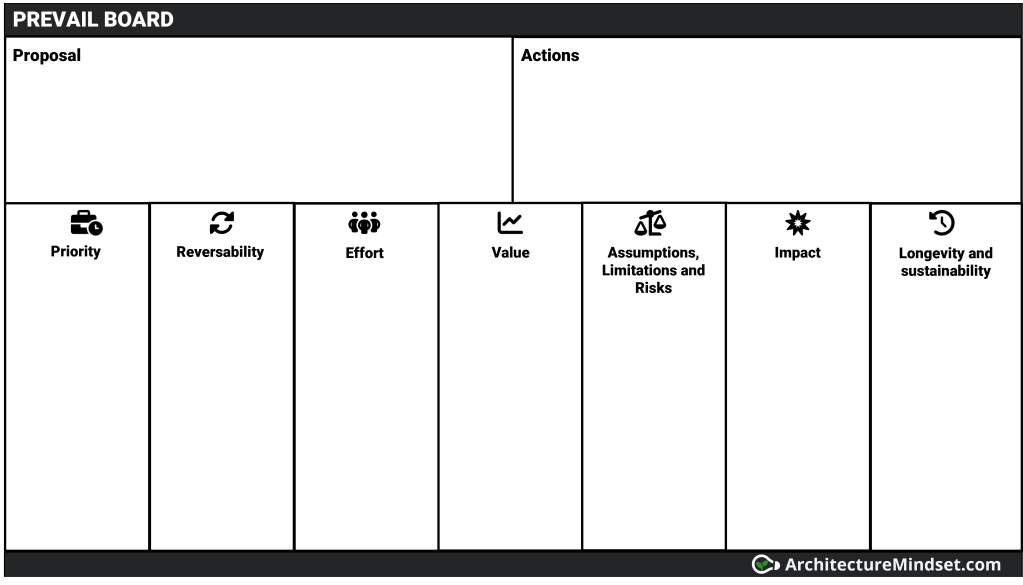
Proposal Presentation
The purpose of the proposal presentation is to create a common understanding of the proposed change. Complex change proposals may take some time to describe, and the participants are likely to have questions. It is important to take sufficient time to discuss the proposal and make sure everyone is on the same page before considering the Key Factors of the change. When a common understanding has been reached, the architect can create a summary on the board with the central points of the proposal.

When working with change proposals, there may be several alternative proposals to achieve the same business value. These alternative proposals may be assessed together, each with their own PREVAIL board. Providing the proposal summary allows the team to distinguish between the different proposals.
Key Factor Benefits and Challenges

With a common understanding of the proposal, the team can proceed with detailing the benefits and challenges in each of the PREVAIL Key Factors. Team members can write down challenges and benefits on sticky notes and place the notes under each Key Factor. The team can then use the challenges and benefits for each Key Factor as a basis for discussion, and group notes into common topics.
Define Actions
After applying challenges and benefits to the change proposal, the team may feel that there is a lack of information or may not fully agree on the perceived challenges and benefits. In order to reach agreement, actions may be required to gather more information or align perspectives. The team can detail actions on the board as the workshop progresses. The team can then pursue the agreed actions and later return for a further workshop to update the benefits and challenges, incorporating the newly gathered information. Depending on the complexity of the change proposal, this may take several iterations.

Feasibility Rating
Once the team has a common perspective of the benefits and challenges, the team needs to discuss the feasibility of the change proposal. The Key Factors provide an understanding of how difficult the change will be to implement, and in order to make a decision on the change, we need to know that the proposed change is realistic and worthwhile from a business perspective.
The feasibility is dependent on the context of the business, for example, is budget widely available, are deadlines realistic, and is there sufficient support in the organization to drive the change. The following categories are used to rate feasibility:
- Manageable The given Key Factor is seen as manageable within the current context and is not a concern to the success of the change proposal.
- Somewhat Manageable The Key Factor may present some difficulties, but these represent a low level of risk to the success of the change proposal.
- Moderately Challenging There are challenges with the Key Factor, but with planning and mitigation, these can be overcome to achieve success.
- Significantly Challenging There are significant challenges with the given Key Factor which will require attention and effort in order for the change proposal to succeed.
- Highly Challenging The key factor has a number of highly challenging areas which can obstruct the success of the change proposal.

Each member of the team rates each Key Factor in terms of feasibility using a number according to the category. After rating each Key Factor, each member can motivate their ratings and discuss them with the team. Finally, the team should agree on a single rating per Key Factor, which will illustrate the feasibility of the change proposal as a whole. This collaboration method shows how a team can work with the PREVAIL Board; however, this method can also be used by an architect to analyze and rate change proposals even when there is no team involved.
Communicating the Feasibility of Change
After the architect is satisfied with the result of the assessment, the resulting feasibility of the change proposal is usually presented to the various stakeholders. These stakeholders may include those responsible for approving the change, the teams who will be responsible for implementing the change, the stakeholders who originally proposed the change, as well as others within the business who may be impacted by the change. In any case, it is important that the architect can effectively communicate the feasibility of the change proposal, highlight challenges, and make a recommendation to stakeholders for a decision, or motivate a decision that the architect has a mandate to make.
The ratings from the PREVAIL Board provide an excellent basis for creating a visual profile of the change proposal feasibility. This is captured in a PREVAIL Profile, which will give stakeholders an idea of how challenging the change proposal is and can highlight specifically which Key Factors require extra attention if the stakeholders decide to move forward with the proposal.
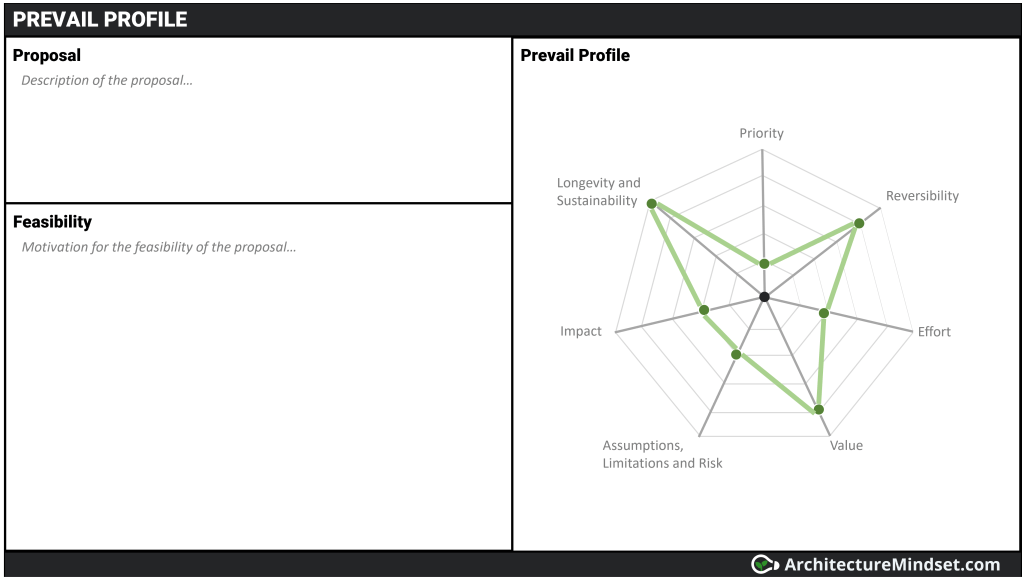
The PREVAIL Profile provides stakeholders with a short description of the proposal, a visualization of the PREVAIL Key Factor feasibility, and a motivation that describes why Key Factors are manageable or challenging.
The centerpiece of the presentation is the PREVAIL Profile Chart. This is a radar diagram that uses the ratings from the PREVAIL Board to create a profile for the change proposal. The points are plotted with the Manageable (1) rating closest to the center of the radar diagram and the Highly Challenging (5) rating furthest from the center of the diagram. This means that diagrams with a small area plotted represent a high level of feasibility, while diagrams covering a large area represent a lower level of feasibility. However, this is not an exact science, since a single Key Factor with a Highly Challenging rating could make a proposal infeasible. This is why it is important to complement the diagram with a textual motivation for the ratings, so that stakeholders can not only see the visual representation but also understand why a particular Key Factor represents a challenge.

In the example PREVAIL Profile diagram, it can be seen that the proposal has challenges in reversibility. This may well be that the change is difficult to reverse after deployment and the organization does not have the resources to cope with such a situation, causing disruption to the business.
It is common when working with architecture that there are several change proposals that can be executed to achieve the same or similar end result. In other words, the architect has several alternatives that need to be compared, and a decision can be taken on the best alternative.

The PREVAIL Profile can help in comparing alternatives using the PREVAIL Profile Chart as visual support. The architect can give a brief description of the alternatives and list the Profile Charts side by side. This provides stakeholders with a visual comparison of the alternatives, and the architect can guide the stakeholders through the details. When selecting or recommending a particular alternative, the architect will provide a textual motivation in the PREVAIL Profile that forms the foundation for making a decision.
Using the PREVAIL Profile method regularly when reporting the result of an assessment will help stakeholders to quickly assess and understand the feasibility of a proposal, and this facilitates effective decision-making.
Summary
The PREVAIL Board and PREVAIL Profile provide architects with a structured and repeatable way to work with teams and stakeholders to assess architecture change proposals and communicate their feasibility. By using collaborative techniques in workshop form, architects can build a shared understanding of benefits, challenges, and risks. The visual and textual presentation of the PREVAIL Profile support clear communication, comparison of alternatives, and informed decision-making, helping organizations increase their success rate in architecture change initiatives.

The Architecture Mindset Articles and Material by Stephen Dougall are licensed under a Creative Commons Attribution-NonCommercial 4.0 International License.
 Architecture Mindset