➔ VIEW LIBRARY ➔ STRATEGIC VIEWS

DESCRIPTION
This view can be used to visualise the objectives for a business, program or project. Having a clear description of objectives is a key factor in directing any organisation. Note that, in this view, objectives and goals are interchangeable terms. This view contains a set of objective elements that describe the aims of the organisation, and dependency relationships that show dependencies between them, thus forming a network of objectives.
Another way to use this view is to make a single objective more manageable by dividing it into several smaller objectives, which forms a hierarchical structure. This is sometimes known as cascading objectives.
PRACTICAL USAGE
The architect often facilitates the planning of objectives and helps detail the sequence in which they can be accomplished. It is therefore important to understand how objectives interact with each other and for stakeholders to reach a consensus on objectives and their dependencies. The architect can use this view to aid:
- Visualisation
Clearly communicate objectives to stakeholders and teams in a way that is easily understood. - Planning and Prioritisation
Provide an understanding of the relationships between objectives so they can be tackled in the right order. When planning the execution of activities to meet an objective, it is important to be aware of dependencies. - Manageability
Manage complex objectives by breaking them down into smaller objectives, leading to objectives being fulfilled in shorter time cycles. - Effects of change
Analysis of the impact of change on the objectives, for example, when removing or changing objective dependencies.
STAKEHOLDERS
Strategic Stakeholders
Strategic stakeholders have an interest in this view for defining and understanding the relationships between long-term business objectives. There is a need to effectively communicate objectives in preparation for execution.
Business Stakeholders
It is necessary for business stakeholders to translate objectives into executable programs or projects. Fully understanding objectives enables these stakeholders to give operational teams a clear direction that aligns with the business strategy. The objectives can serve as the basis for status reporting and tracking of execution. The view can also be applied at the tactical level of an organisation to define objectives for specific programs or projects.
Product Stakeholders
Product stakeholders are interested in alignment of product development with business objectives. Measuring product outcomes against the business objectives provides a way of demonstrating that the product is delivering value to the business.
Development Stakeholders
Interest from development and engineering may be limited to the context for the operational work, but understanding the contribution to business objectives can prove highly motivational.
EXAMPLE:
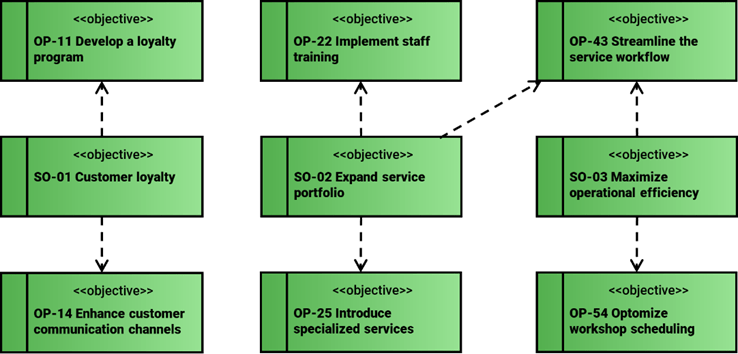
RELATED VIEWS
- Objectives-Transition View
REFERENCES AND FURTHER READING

The Architecturality View Library by Stephen Dougall is licensed under a Creative Commons Attribution-NonCommercial 4.0 International License.
 Architecture Mindset