➔ VIEW LIBRARY ➔ STRATEGIC VIEWS

DESCRIPTION
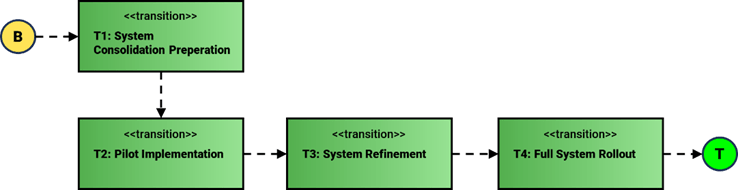
The Transition Plan is often used to outline a strategic plan for the evolution of an architecture from its current state (B = baseline) to its future state (T = target architecture). The elements in this view are transitions, which represent well-defined milestones on the journey toward the target architecture.
Each transition is clearly named and is often associated with a set of strategic objectives. The relationships in the view are flows, which illustrate the sequence in which the transitions will be executed. The execution of transitions can follow a single linear progression, or multiple transitions may execute in parallel.
The architect will construct an architecture for each transition in the plan which are referred to as transition architectures.
PRACTICAL USAGE
The architect can use the Transition Plan to understand how the architecture will evolve over the long term and to develop transition architectures at each stage that align with the organization’s objectives.
The Transition Plan helps with:
- Strategic Roadmapping
The Transition Plan effectively serves as a high-level roadmap that facilitates the planning of major changes to technologies, people, and processes, often over a significant time period (typically 3–5 years). This roadmap helps the architect identify dependencies between transitions, manage them early on, and align these transitions with other initiatives. - Reducing Impact
Major transformations to an architecture can significantly impact an organization. Breaking down an architectural transformation into manageable iterations reduces this impact. The architect can prioritize objectives step by step and adjust the transition architectures accordingly. - Managing Complexity and Detail
Large-scale transformations are complex and present substantial architectural challenges. By providing a time perspective on the transitions, the architect can focus on the details of early transitions while mitigating risk by assessing later transitions. While later transitions require less architectural detail, they provide important context for stakeholders and can be refined as they approach execution.
STAKEHOLDERS
Strategic Stakeholders
Strategic stakeholders have a particular interest in the Transition Plan as it illustrates how the business technology strategy will be executed and ensures alignment with the overall business strategy. This plan provides these stakeholders with essential information on when objectives are expected to be achieved and serves as a focal point for executing initiatives.
Business Stakeholders
Architecture transitions are of interest to business stakeholders as they help assess which areas of the business will be affected. This allows them to prepare detailed execution plans for the immediate transitions and manage the impact of changes on business operations. The Transition Plan provides milestones that various business stakeholders can align with to ensure a smooth transition.
Product Stakeholders
Product stakeholders are primarily concerned with whether the immediate transition will impose requirements or constraints on their product and whether subsequent transitions will significantly impact it. Understanding the Transition Plan enables product stakeholders to prepare and adjust their own product roadmaps to align with the business strategy.
EXAMPLE:
RELATED VIEWS
- Objectives-Transition View
REFERENCES AND FURTHER READING
- Roadmaps, IASA BTABoK [link]
- The Open Group. (2018). Archimate 3.1 [link]
- The Open Group. (2018). Phase F: Migration Planning [link]
- Ross, Jeanne W., Weill, Peter, & Robertson, David. (2006). Enterprise Architecture as Strategy: Creating a Foundation for Business Execution.

The Architecturality View Library by Stephen Dougall is licensed under a Creative Commons Attribution-NonCommercial 4.0 International License.
 Architecture Mindset