➔ VIEW LIBRARY ➔ STRATEGIC VIEWS
DESCRIPTION
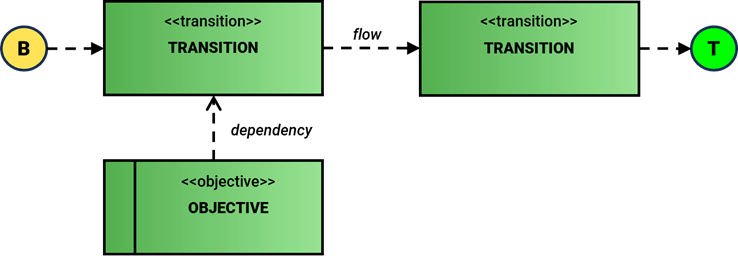
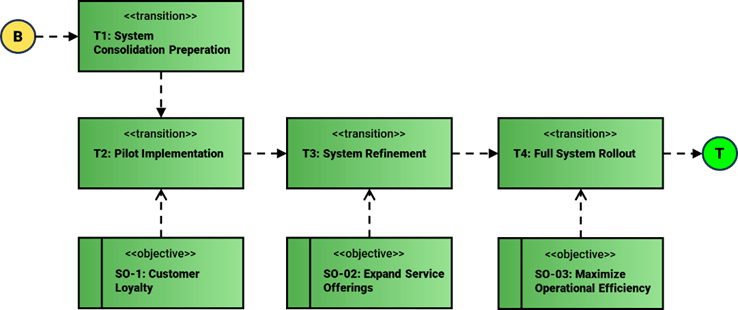
The Objective-Transition View illustrates the relationships between architecture transitions and business objectives. This is a composition of the transition plan and the objectives view, where the elements in this view are objectives and transitions.
There are two types of relationships in this view:
- The flow relationship shows the sequence of the transitions from the baseline architecture (B) to the target architecture (T).
- The dependency relationship indicates which objectives rely on the successful execution of transitions.
Fulfilment of a single objective may be dependent on several transitions, and a transition may be related to several objectives.
PRACTICAL USAGE
This view is used by the architect to understand the sequence in which the architecture transforms and the required objectives that are to be met at each stage. Placing objectives on the transitions provides the fundamental guidance and direction of the architecture. This can assist the architect in the following areas:
- Align Strategy and Execution
By combining objectives with transitions, the architect can uncover many of the challenges in executing a strategy. Dependencies between objectives may influence the sequence or scope of a transition, or constraints in the transition architecture may mean that an objective will require several transitions to be fulfilled. - Guidance and Motivation
Objectives provide both guidance and motivation for constructing a transition architecture. The architect can utilize these objectives as a guiding light, aiding the decision-making process. The objectives can be referenced as a motivation for architecture decisions, providing clarity, reinforcement, and alignment to the business strategy. - Prioritizing Objectives
The clear visualization of transitions and objectives provides insight into when objectives are likely to be fulfilled over time. This may facilitate prioritizing the objectives according to the sequence of execution, especially if certain objectives have time-bound deadlines or are only relevant within a specific window of opportunity.
STAKEHOLDERS
Strategic Stakeholders
The fulfilment of strategic objectives is key for strategic stakeholders. The Objectives-Transition View offers insights into potential challenges when executing a strategy and provides a time perspective for when objectives are expected to be met. This view supports strategic stakeholders in planning and assessing the feasibility of execution.
Business Stakeholders
The Objectives-Transition View details the purpose of transitions by illustrating their relationships to objectives. This presents essential context for business stakeholders. Understanding objectives serves as a motivational factor and influences business decision-making. Awareness of the transitions and objectives enables business stakeholders to measure performance effectively, using KPIs (Key Performance Indicators) to track progress and assess when objectives are met, which provides valuable feedback to strategic stakeholders.
EXAMPLE:
RELATED VIEWS
REFERENCES AND FURTHER READING
- IASA BTABoK, Roadmaps [link]
- The Open Group. (2018). Archimate 3.1 [link]
- The Open Group. (2018). Phase F: Migration Planning [link]
- Ross, Jeanne W., Weill, Peter, & Robertson, David. (2006). Enterprise Architecture as Strategy: Creating a Foundation for Business Execution.

The Architecturality View Library by Stephen Dougall is licensed under a Creative Commons Attribution-NonCommercial 4.0 International License.
 Architecture Mindset