➔ VIEW LIBRARY ➔ STRATEGIC VIEWS
DESCRIPTION
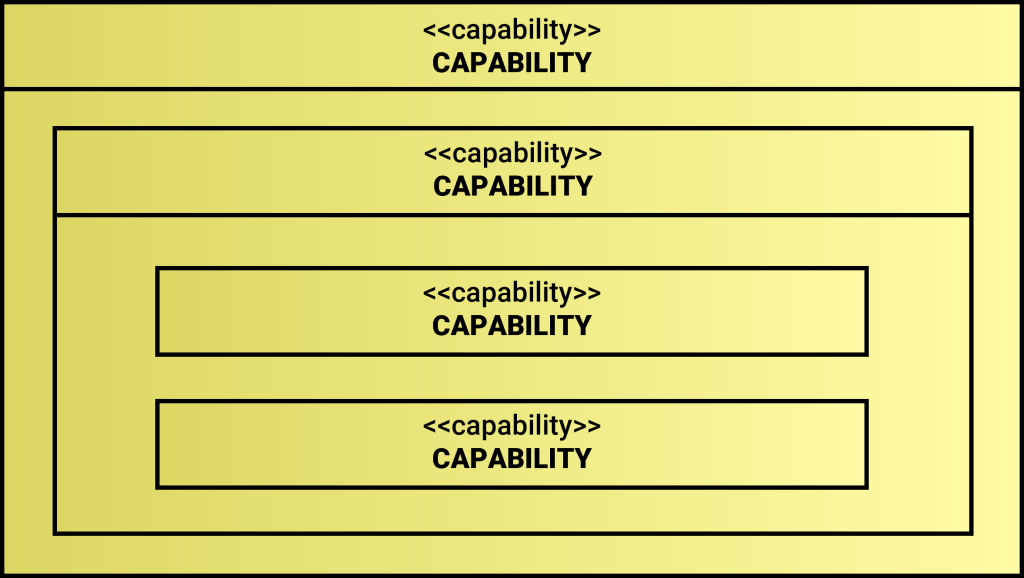
A Capability Map is commonly used to identify the capabilities an organization needs to deliver services and ultimately provide value to the end customer. It consists of capability elements that represent the people, processes, and technology required to deliver services both internally and externally. Capabilities are organized hierarchically, with each element potentially broken down into multiple levels of sub-capabilities. This decomposition helps make complex or large capabilities more manageable and easier to understand.
The Capability Map may represent existing capabilities within an organization, as well as those the organization must develop to deliver desired services. Note that the Capability Map addresses what an organization must be able to do, not how it will do it.
PRACTICAL USAGE
It is important for the architect to gain an understanding of what the business does or needs to do in order to create value. This is key when developing a business technology strategy. The Capability Map provides a great way of visualizing both existing and planned capabilities. This helps the architect support stakeholders in the following areas:
- What the Organization Does
As a general communication tool, the Capability Map provides a representation of what the business does, which can be easily understood by many stakeholders both inside and outside the organization. This supports the architect in many scenarios when providing context for any given architecture initiative. - Strategic Planning
When moving a strategy to execution, it is important that the architect understands the required capabilities needed from the organization, and how these capabilities align with the strategic goals of the organization. This serves as a basis for developing a business technology strategy (BTS), which targets high-value capabilities for further development and optimization. The Capability Map supports the architect in analyzing and communicating strategic plans. - Designing the Operating Model
In order to deliver capabilities, these must be underpinned with an operating model that facilitates the delivery of services and aligns well with the structure of the capabilities. The Capability Map provides the fundamental structure from which the architect can identify the need for organizational structures, roles, and processes that support capabilities in a clear and efficient way. - Competencies and Skills
Defining the required capabilities in an organization provides valuable information regarding the potential requirement for business and technology competencies needed to deliver services. The Capability Map provides the architect with a platform for mapping skills to different areas of the organization to ensure that the architecture is operable. - Investment Planning and Analysis
The business strategy and objectives influence which capabilities in an organization are considered high-value, and therefore attract more investment. It is essential for the architect to understand where focus areas are in the organization and drive architectural initiatives and investments that contribute to the optimization of capabilities. The Capability Map provides structures for applying investment which is aligned with the organization’s strategy and for measuring the value of the outcome.
STAKEHOLDERS
Strategic Stakeholders
Capabilities are of interest to stakeholders at the strategic level, as they lay the foundations for illustrating what the organization needs to do in order to meet the strategic goals. These stakeholders have a vested interest in identifying essential capabilities and aligning the tactical and operational levels of the business with these capabilities. The Capability Map visualizes capabilities and forms a basis for strategic planning, reporting, and governance.
Business Stakeholders
The business and operational models maintained by business stakeholders need to be aligned with the capabilities that are essential to meeting strategic objectives and delivering business services. The Capability Map facilitates business stakeholders in planning, prioritizing, and providing decision support for initiatives and assignments that influence or change the organization’s capabilities.
Product Stakeholders
Planning and prioritizing changes to products and defining the scope of product releases is a key concern for product stakeholders. Products are developed to support capabilities within the organization, and the Capability Map can aid product stakeholders by providing a framework for gathering requirements and exploring the processes and people the product will support.
Development Stakeholders
Capabilities provide valuable context for a product that development stakeholders can use, especially when engaging in user-centric design. The Capability Map can aid development stakeholders in understanding the scope of change and facilitate technical decision-making by balancing priority, value, and effort.
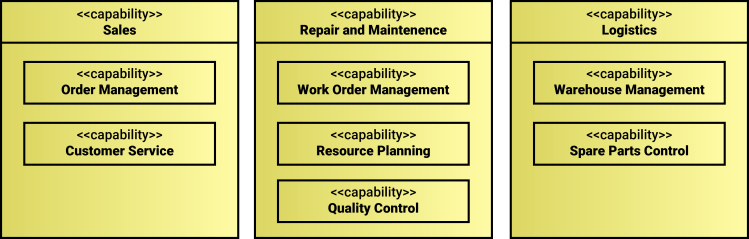
EXAMPLE:
RELATED VIEWS
- E01 Objectives [link]
REFERENCES AND FURTHER READING
- Business Capabilities, IASA BTABoK [link]
- The Balanced Scorecard—Measures That Drive Performance., Kaplan, Robert S., and David P. Norton, Harvard Business Review, January–February 1992.
- BIZBOK® Guide – Capability Mapping, The Business Architecture Guild [link]
- Business Architecture: The Art and Practice of Business Transformation, Authors: William Ulrich & Neal McWhorter
- TOGAF – Business Capabilities, The Open Group [link]

The Architecturality View Library by Stephen Dougall is licensed under a Creative Commons Attribution-NonCommercial 4.0 International License.
 Architecture Mindset