➔ VIEW LIBRARY ➔ SOLUTION VIEWS
DESCRIPTION
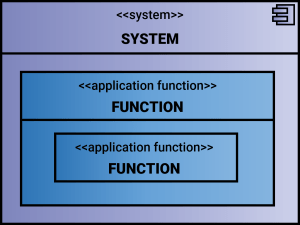
The Application Function Map depicts the functional hierarchy of an application. The view uses decomposition to separate an application into functional areas, which in themselves can be decomposed into smaller functions. This provides the functional scaffolding for an application. The elements used in this view are system, which represents the application containing the functions, and application function, which represents the various functions or features of the application. The composition relationship is used to show the hierarchical structure of application functions, often represented in a block diagram.
PRACTICAL USAGE
When constructing a solution architecture, the architect has to understand the functions or features that the solution will provide and organize these in a fashion that gives context for the application. This is essential for communicating the key functions of the application and provides the basis for functional encapsulation, which supports the architect in the following areas:
- Mapping Requirements
When managing requirements for a solution, the architect can categorize them into functional areas. The Application Function Map supports placing requirements in the context of an application’s features and functions. - Functional Scaffolding
The functional structure of an application provides the scaffolding for building features and organizing components and source code. Breaking the functions down into smaller functions makes the complexity of the application manageable and supports the planning of product development. - Architecture Alignment
The broad functional structure of an application facilitates the alignment of design across architecture layers. The design of components such as user interfaces, APIs, services, and databases can be aligned to a uniform functional structure, which makes the application easier to maintain. - Foundation for Testing
Visualizing the functional structure of an application facilitates the design of test suites and test cases. Tests can be planned and designed for each application function in a well-organized fashion to ensure good test coverage. A shared understanding of an application’s functional structure supports acceptance testing by providing alignment between application functions and requirements. - Manage the Functional Lifecycle
A clear definition of the functional structure of an application supports the architect in managing the evolution of functions that add value to the application, and the decommissioning of functions that are no longer required. This ensures that the application remains healthy and extends the lifetime of the application.
STAKEHOLDERS
Business Stakeholders
Business stakeholders have a vested interest in understanding which applications support business processes and services without concerning themselves with low-level details. The Functional Application Map provides these stakeholders with a clear and easily understandable illustration of the high-level functions within an application.
Product Stakeholders
A shared understanding of an application’s functional scaffolding is a key concern for product stakeholders. It offers a clear map of the application’s functional landscape, forming the foundation for gathering requirements and creating high-level functional designs. Product stakeholders use the Functional Application Map to coordinate planning with development teams, ensuring that activities and roadmaps are aligned with the application’s functional structure.
Development Stakeholders
Development stakeholders depend on a clear functional structure design to effectively plan workflows, further develop detailed designs, and implement application features in a well-organized and coherent manner. The Functional Application Map facilitates alignment of implementation with design, ensuring consistency across the application implementation. It also provides a solid foundation for functional decomposition, supporting efficient testing, troubleshooting, and long-term maintenance of the application.
EXAMPLE:

RELATED VIEWS
- –
REFERENCES AND FURTHER READING
- “Architecture of Integrated Information Systems (ARIS)” by August-Wilhelm Scheer – Function View
- Archimate – Application Function element [link]

The Architecturality View Library by Stephen Dougall is licensed under a Creative Commons Attribution-NonCommercial 4.0 International License.
 Architecture Mindset