➔ VIEW LIBRARY ➔ TACTICAL VIEWS

DESCRIPTION
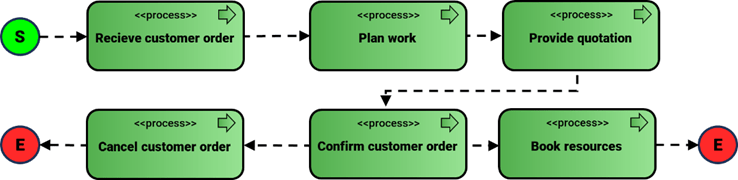
The Business Flow View offers a high-level depiction of business process execution within an organization. This view highlights the key processes and the sequence in which they flow. Each flow may have several start points (S) or end points (E) and includes a series of process elements.
The relationships in this view are flows, showing the direction of travel to each element. A process may have several flows connecting to other processes, start points, or end points. The stereotype detailed on the process can be used to indicate different types of processes — for example, internal or external processes.
It is important to note that this view intentionally omits the low-level details of a process, as the aim is to provide a broader context of how an organization works.
PRACTICAL USAGE
The architect can use this view to develop an understanding of how the key processes within an organisation work. This can aid the architect in identifying technology opportunities that support business processes or in assessing the impact of architectural change on business processes. The Business Flow View assists the architect in the following areas:
- Impact Assessment
When planning a transformation, the architect needs to understand how the organisation will be affected. Business flows provide a means to assess which processes will be impacted, determine risk, and plan for mitigation. - Efficiency Evaluation
The architect can map current business processes into business flows to identify inefficiencies, such as bottlenecks or administration-heavy processes. Processes can be made more efficient through automated technologies or by changing the nature of the business flow itself. Identifying key processes within the flow supports the prioritisation of work and faster realisation of benefits. - Managing Requirements
Understanding the business flow is an essential part of gathering functional and non-functional requirements for supporting the business. These requirements define the scope of what is to be achieved by a digital transformation or the development of a solution and drive architectural decisions. - Context for Solutions
When developing a solution from a requirement specification, it is important to understand the context of the requirements. Business flows provide a valuable tool for architects in both clarifying how a planned solution will work and validating a solution against the needs of the organisation.
STAKEHOLDERS
Business Stakeholders
Business stakeholders have a significant interest in the Business Flow as it shows how planned transformations will affect the behaviour of the organization. This facilitates collaboration with the architect and the validation of stakeholder needs. Understanding business flows is valuable to these stakeholders, as it provides the basis for planning activities to minimise disruption to the business. The organisation can prepare personnel, for example, through training in new technologies or processes.
Product Stakeholders
When describing the requirements for a given product, it is important that the context of these requirements is understood. Business flows help product stakeholders communicate the context of product requirements and provide the foundation for alignment between the business and the product. Product stakeholders can refine business flows at the product level to aid in the design of user-centric flows describing the function of an application.
Development Stakeholders
When constructing a technical solution, development stakeholders need to understand the context in which they are developing the solution. The Business Flow provides this context, enabling developers to make well-grounded design and implementation decisions. It offers these stakeholders a broader view of expected usage and facilitates anticipation in the design and implementation process.
EXAMPLE:
RELATED VIEWS
- –
REFERENCES AND FURTHER READING
- Open Group, Archimate – Business Process [link]
- BPMN (Business Process Model and Notation) – Developed by OMG (Object Management Group, 2004–present) [link]
- Davenport, Thomas H. – Process Innovation: Reengineering Work through Information Technology (1993)

The Architecturality View Library by Stephen Dougall is licensed under a Creative Commons Attribution-NonCommercial 4.0 International License.
 Architecture Mindset