➔ VIEW LIBRARY ➔ TACTICAL VIEWS

DESCRIPTION
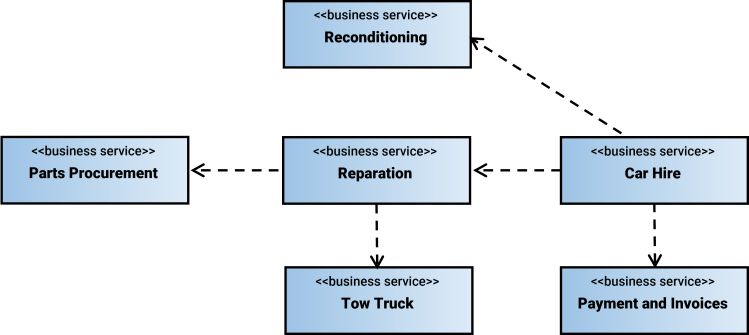
Business Services represent a well-defined functional unit within an organization that describe how value is delivered to the consumers of the service. The business service is a representation of people, processes, and technologies needed to deliver value to the consumers of the service. The Business Service view illustrates the business services within an organization and the dependencies between these services.
The business service element is used to represent the services, and the dependency relationship is used to indicate dependencies between the services.
PRACTICAL USAGE
The intention in this view is to support the architect in understanding the services that deliver value to external consumers and the internal services required to ensure effective operation of the business. The Business Service view aids the architect in the following areas:
- Categorize Business Services
The architect can assess and group business services into several categories that make them manageable and can differentiate services based on the following:- Core – Directly support the primary flow of business value delivery and are critical services.
- Support – Enables supporting functions. While not essential to value delivery, they can be essential to business operation.
- Shared – Generic services that may be used across many domains.
- Enabling – Support the Core services and are indirectly critical services.
- Consumer Driven Value
Working with the Business Service view, the architect can develop services based on value as expressed by the needs of consumers. Placing the focus solely on business services allows the architect to work with the architecture in a value-driven manner and describe the need for services rather than getting bogged down in the details of capabilities, organizations, or realization. - Capability Discovery
Defining business services facilitates the architect in identifying capabilities that the organization does not yet possess but are needed in order to deliver certain services. This can influence the business technology strategy, illustrating risks and opportunities. - Identify Dependency Flows
Visualizing the dependencies between business services helps the architect identify critical chains of services in the organization. Understanding the dependency flows supports the architect in a number of analytical tasks, such as the impact of change, identification of security-critical services, and candidates for rationalization and consolidation.
STAKEHOLDERS
Strategic Stakeholders
Strategic Stakeholders have an interest in the operation of business services that are key to achieving strategic objectives. The Business Service view can illustrate key services for investment and highlight gaps in capabilities that have to be addressed in order to meet strategic goals. The identification of new business services can provide insights, open opportunities, and give the organization a competitive advantage. This supports Strategic Stakeholders in adapting the business technology strategy.
Business Stakeholders
Understanding the dependencies between business services is of great value to Business Stakeholders as it aids them in aligning the operational aspects of the organization with strategic capabilities. The Business Service view provides these stakeholders with insights into critical paths between the services and can highlight bottlenecks in the delivery chain. This view supports Business Stakeholders in conducting a change impact analysis when making significant changes, for example, major modifications to business processes or the introduction of new technologies.
Product Stakeholders
Products play an important part in realizing the business services, and Product Stakeholders have a significant concern in understanding the business services that their products support and the requirements that they place on the product. The Business Service view shows Product Stakeholders the landscape of business services, which provides context for products, aids in understanding end-users, and supports the definition of application functions. The relationships between the business services provide indicators for potential integrations with other systems.
Development Stakeholders
While Development Stakeholders are perhaps more focused on application functions, the illustration of business services provides a broader context. In some cases, this can help motivate and provide a better understanding of the system needs during detailed design, and this also facilitates verification and validation.
EXAMPLE:
RELATED VIEWS
REFERENCES AND FURTHER READING
- IASA. Business Technology Architecture Body of Knowledge (BTABoK) – Services [link]
- Open Group. Archimate – Business Service [link]
- OMG (Object Management Group, 2004–present). “BPMN (Business Process Model and Notation) [link]
- The Business Architecture Guild. BIZBOK® Guide [link]

The Architecturality View Library by Stephen Dougall is licensed under a Creative Commons Attribution-NonCommercial 4.0 International License.
 Architecture Mindset